Why this site covers the word “bubbler” separately
Because it is the word buyers actually type, and because it does not mean what the industry thinks it means.
Manufacturers, spec sheets, and trade publications say de-icer. Buyers say bubbler. In first-party search data covering a full de-icing season, dock-side queries using “bubbler” outnumbered “de-icer” queries roughly two to one and drew clicks at nearly three to one. Across the whole category the word appeared in 571 distinct query rows.
The problem is that a large share of those searchers are using “bubbler” to describe a propeller de-icer, which contains no compressor and produces no bubbles. So a buyer searching for a bubbler, reading a page about bubblers, and buying something called a bubbler can still end up with the wrong machine for their water. Untangling that is the purpose of this section.
What are the two kinds of dock bubbler?
| Propeller de-icer (often sold as a “bubbler”) | Compressed-air bubble curtain (a true bubbler) | |
|---|---|---|
| What moves the water | A submerged motor turning a propeller | Rising air bubbles from perforated tubing |
| Where the machine sits | In the water, suspended or mounted | Compressor on shore or dock; tubing on the bottom |
| Electricity in the water | Yes, submerged motor on a cord | No, only air lines below the surface |
| Shape of the opening | A circle or an oblong, from one point | A line, along the length of the tubing |
| Best suited to | Targeted protection where a warm bottom layer exists | Long linear runs; no electricity in the water |
Both work on the same underlying principle: bring deeper water to the surface faster than the surface can freeze. Neither one heats anything.
How do I know which one my dock needs?
Start with depth, because depth is what makes a propeller unit work or fail.
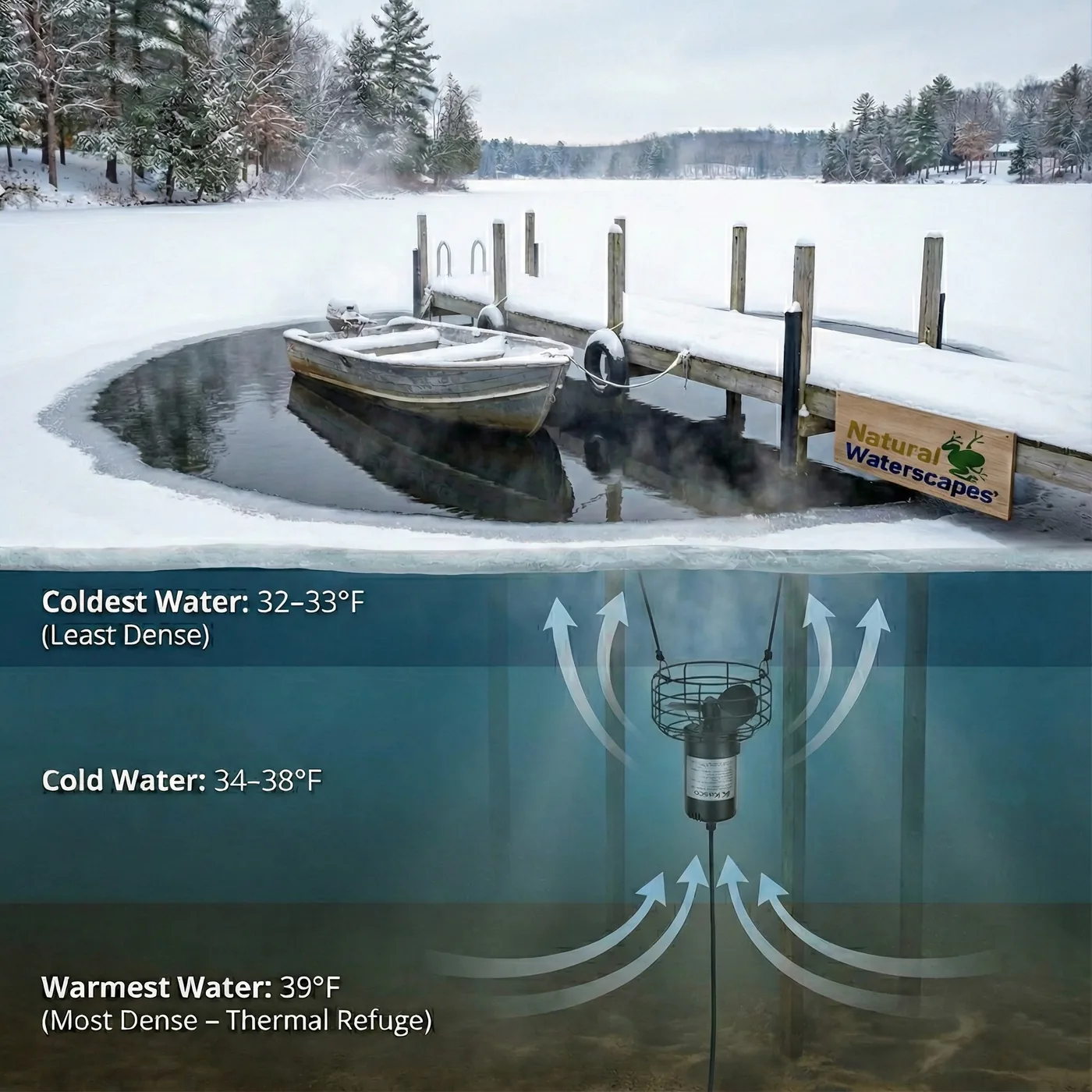
A propeller de-icer depends on there being warmer water at the bottom to lift. In winter, fresh water forms an inverse layering: because water is densest at 39.2 degrees F, the warmest water in the lake sits on the bottom while the coldest sits under the ice. A de-icer works by mining that bottom layer. Take the layer away and the machine has nothing to do.
Kasco publishes a 4 ft minimum water depth for every D-Series de-icer. Treat that as the floor rather than the target. Our recommendation is 6 ft. Below roughly 6 ft a water column mixes readily under wind and loses the stable warm bottom layer a propeller de-icer depends on, so a unit sitting in 4 ft of water is meeting the specification while delivering much less than the coverage tables suggest.
- Comfortably deep water, targeted area. A propeller de-icer is usually the right answer. Size it with the sizing calculator.
- Water that will not stratify reliably. A compressed-air curtain does not depend on a warm bottom layer, so it tolerates conditions that defeat a propeller unit. It still needs depth of its own: CanadianPond states 4 to 20 ft, and its open-water width is roughly two to three times the diffuser depth depending on how cold it gets.
- A long dock face or shoreline run. A curtain opens a line. Getting the same result from point-source units means several of them.
- One slip, a boat lift, a piling cluster. A propeller unit is directional and can be aimed.
The full physics and the complete comparison table are in dock bubblers vs de-icers.
Do bubblers use less electricity than de-icers?
The claim is common, but we have not found it supported with measured figures. This site will not assert it until someone does.
Two separate problems sit underneath the question. First, no compressor power figures have been verified from primary sources for this project, so there is no measured basis for the comparison. Second, and more fundamentally, manufacturers across this whole category publish amps, and buyers need dollars. Volts times amps gives apparent power in VA, which equals real power in watts only at a power factor of 1.0, and induction motors of this class run well below that.
What that means practically: any monthly running-cost figure you see for a de-icer or a bubbler that was calculated from an amp rating is an overestimate by an unknown margin. See power draw and running cost.
What does this site not yet publish about bubble curtains?
The specifics, and deliberately so.
Compressor CFM requirements, tubing perforation spacing, maximum run lengths, and minimum depth ratings for compressed-air systems have not yet been pulled from manufacturer primary sources for this project. The figures circulating for these are largely from retailer blogs, and reproducing them here would put unverified numbers behind a hydrologist's name.
What is published is mechanism, geometry, and the selection logic above, all of which are supportable. When primary bubble-curtain sources have been obtained, the specifications will appear on the bubble curtain equipment reference under the same sourcing and dating standard applied to the Kasco and U.S. Solar Mounts references.
Is a dock bubbler the same as an Ice Eater?
ICE EATER is a registered trademark of Bearon Aquatics, not a category name, and the products it identifies are propeller de-icers. So an “ice eater” is one brand of the propeller type, not the compressed-air type, regardless of how the word gets used in conversation.
Between “bubbler,” “de-icer,” and “ice eater,” this category has three common names for the same equipment and none of them is used consistently. See is an Ice Eater the same thing as a dock de-icer?