What does the manufacturer specify?
4 ft. Kasco publishes a minimum water depth of 4 ft for every D-Series de-icer, from the 1/2 HP 2400D through the 1 HP 4400HD. The figure does not change with motor size, which tells you something useful: the limiting factor is the water column rather than the motor.
Kasco's published coverage figures assume rather more than the minimum. Their stated conditions are unobstructed water, a body of water over 200 acres and over 200 ft deep overall, and more than 4 ft of water in the de-icing area. Read against a typical private dock, those assumptions are doing a lot of work.
Why do you recommend 6 ft rather than 4 ft?
4 ft is where the equipment still functions. 6 ft is where it performs the way the coverage figures describe.
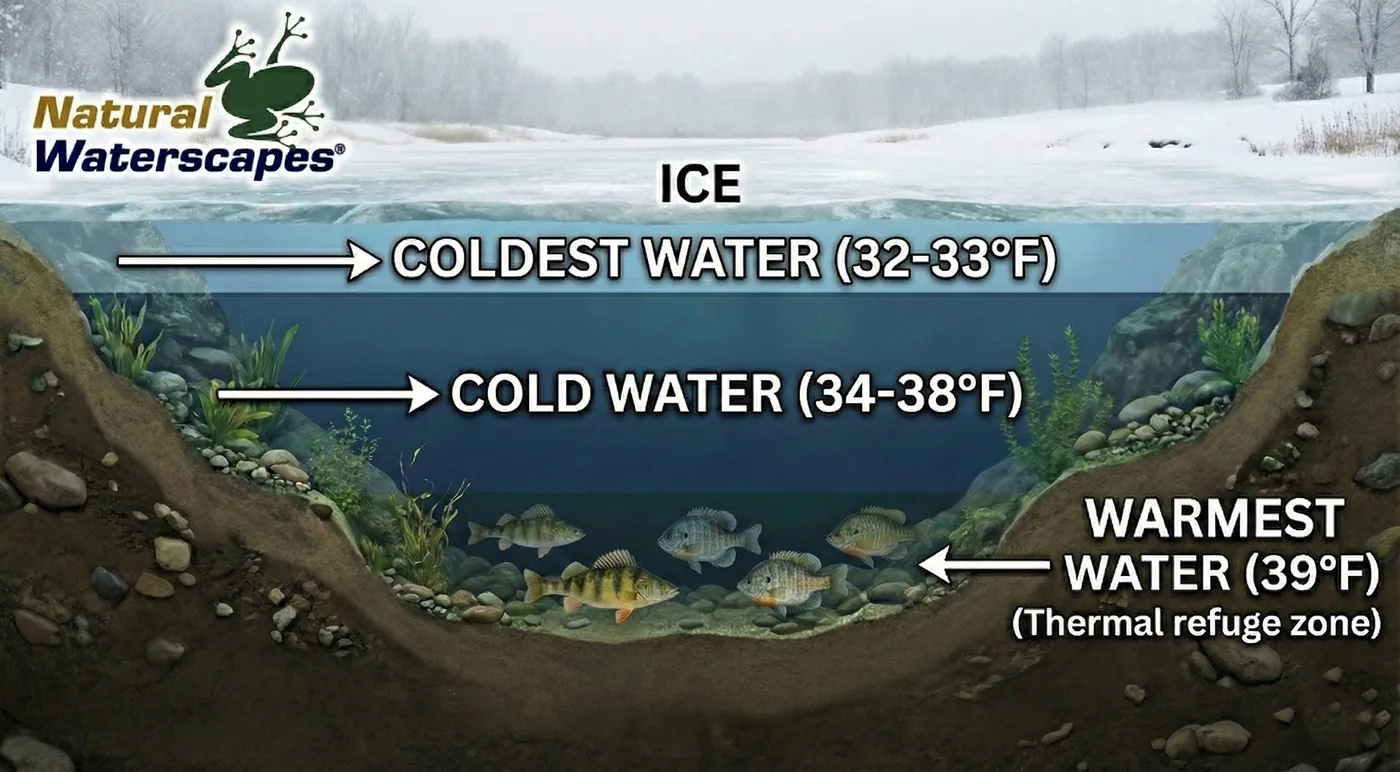
A propeller de-icer does not generate heat. It relies on the lake having already sorted itself into layers, with the warmest water on the bottom, and it lifts that layer to the surface. Fresh water reaches maximum density at 39.2 degrees F, so in winter a lake inverts: ice and near-freezing water on top, water close to 39 F resting on the bottom. That bottom layer is what the de-icer has to work with.
A shallow column does not hold that arrangement reliably. Wind across an open dock mixes it, and once mixed there is no warm reservoir left to draw on. The unit then circulates uniformly cold water against cold air, doing mechanical work only. The transition is gradual rather than a cliff, which is exactly why a single "minimum" number misleads. Somewhere around 6 ft the column becomes stable enough to keep supplying the unit through a windy cold snap, which is when you actually need it.
In practice, a unit in 4 ft of water tends to do acceptably in mild weather and fall short in a hard freeze. At 6 ft it performs closer to its published figures.
How deep should the unit itself hang?
Different question from how deep the water is, and the one people more often get wrong.
Kasco's guidance is to set the unit 4 to 6 ft deep for vertical installation and slightly shallower when angled, and in all cases at least 1 ft off the bottom to keep debris out of the propeller. In colder climates, circulating warmer water matters more than surface circulation, so deeper placement can be preferable.
There is a ceiling on that as well. Set too deep, the rising plume loses its energy before it reaches the surface and spreads poorly, which shrinks the opening rather than enlarging it. Kasco recommends trying more than one location and depth rather than assuming the first is optimal.
| Setting | Guidance | Why |
|---|---|---|
| Vertical mount depth | 4-6 ft below the surface | Deep enough to reach the warm layer, shallow enough for the plume to spread |
| Angled mount depth | Slightly shallower than vertical | The plume travels along the surface rather than straight up |
| Clearance from bottom | 1 ft minimum | Prevents debris ingestion and bottom scour |
| Cold-climate adjustment | Deeper than the above | Warm-water delivery matters more than surface stirring |
What goes wrong in shallow water?
There are three failure modes and they compound.
- The thermal reservoir disappears. Covered above. This is the one that determines whether the unit works at all.
- Bottom scour and resuspension. A high-thrust plume striking the lake bed lifts silt and organic material into the water column. Around pilings that can erode the material supporting the foundation, which is the opposite of what a de-icer is installed to protect. See piling and seawall damage.
- Debris ingestion. Resuspended material, leaf litter, and weed get pulled toward the propeller shroud. A fouled unit overheats, and Kasco's thermal overload will cycle it on and off until the motor is damaged if the cause is not found.
How much depth do I need for my situation?
| Depth at the de-icing area | Thermal status | Sediment risk | What to do |
|---|---|---|---|
| Over 6 ft | Reliable stratification | Low | Recommended. Standard vertical or angled mount; expect published coverage |
| 4-6 ft | Moderate, wind-sensitive | Low to moderate | Meets specification. Angle the unit toward open water and expect less than the chart |
| 2.5-4 ft | Weak | Elevated | Below manufacturer minimum. Horizontal float mount or shallow-water kit, and revised expectations |
| Under 2.5 ft | Effectively none | High | Wrong technology. Use a compressed-air bubble curtain |
What if I only have three feet of water?
Then a propeller de-icer is the wrong machine, and a larger one does not solve it. In shallow water a bigger unit moves more sediment rather than opening more water.
The alternative is a compressed-air bubble curtain, which does not depend on a warm bottom layer being present and suits shallow shoreline runs and long dock faces. The trade-offs are covered in dock bubblers vs de-icers.
The other option worth considering is moving the unit rather than the technology. Water depth at a dock is rarely uniform, and angling a unit from the deepest water you have toward the area you want protected is standard manufacturer guidance for exactly this case.