How Do Dock De-Icers Work and Why Does Water Depth Matter?
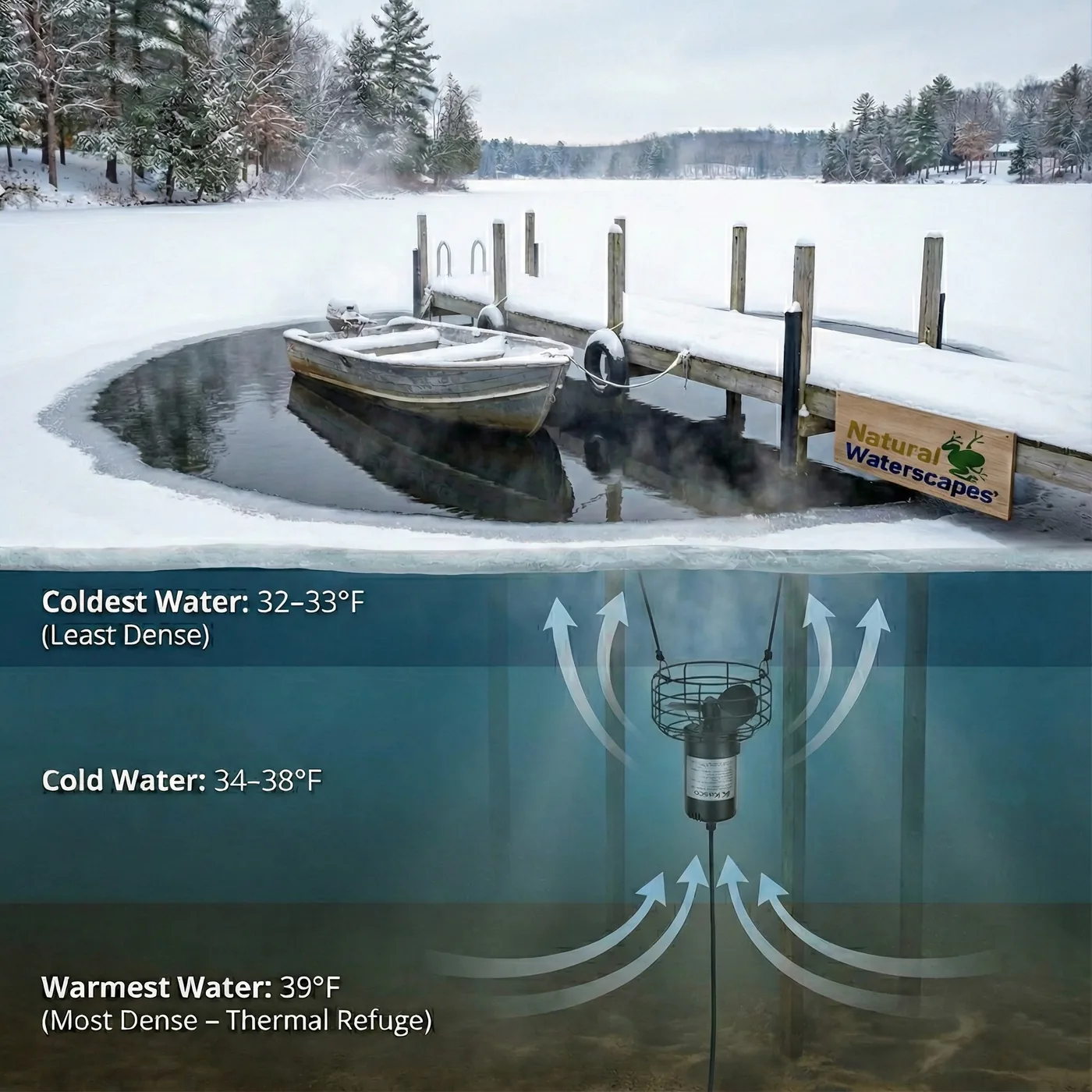
Marine de-icers work by drawing relatively warm water from near the lake bottom and directing it upward to melt ice and prevent freezing at the surface. Fresh water is most dense at 39.2 degrees F (4 degrees C) and settles at the bottom in winter. In shallow water -- commonly cited as under about four to six feet -- this layering breaks down, which makes propeller de-icers far less effective.
A de-icer does not melt ice. It is an axial thermal pump: it entrains the warmest, densest water in the system — which under winter ice sits on the bottom — and discharges it at the surface. Note what the arrows do not do: the cooled surface water never returns to the bed, because at 32–33°F it is the lightest water in the lake. It spreads sideways instead, while the reservoir below is drawn steadily down. That is why depth is the constraint. Set depth follows the Kasco O&M manual; the 12 ft column, ice thickness and opening width are illustrative, not site measurements. Illustration: Natural Waterscapes LLCA de-icer does not melt ice. It lifts the warmest water in the system, which in winter sits on the bottom, and keeps it moving at the surface. Illustration: Natural Waterscapes LLC
The Density Curve of Water
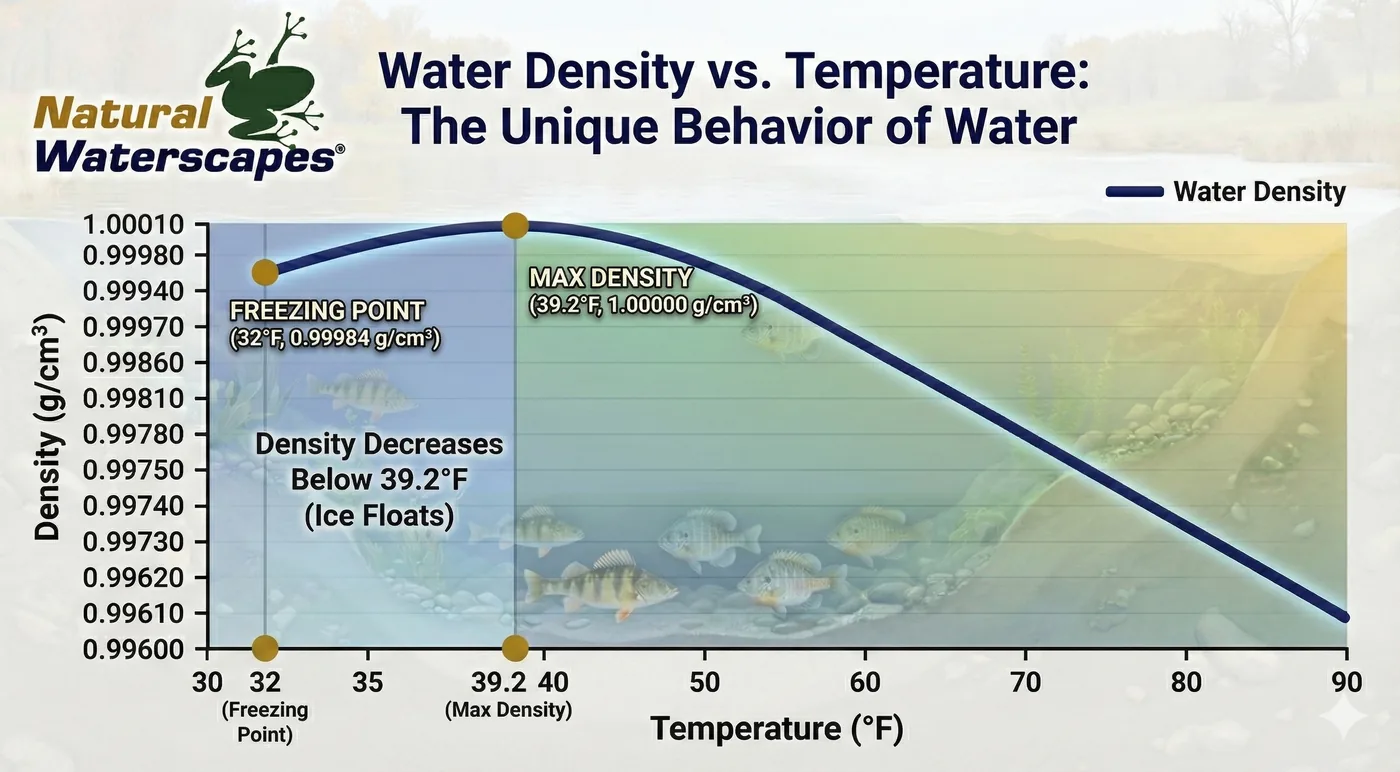
Fresh water contracts as it cools until it reaches 39.2 degrees F. Below that point it expands again as it approaches freezing, becoming lighter. In winter, deeper lakes stratify: colder water sits just under the surface ice while the comparatively warmer 39.2 degree F layer stays trapped near the bottom. A propeller de-icer acts as an axial thermal pump, pulling that bottom layer upward to melt ice.
The anomaly the whole category depends on: fresh water is densest at 39.2 degrees F, not at its freezing point. That is why ice floats and why a winter lake holds its warmest water at the bottom. Illustration: Natural Waterscapes LLC
Depth Stratification Performance
Water Depth Zone
Thermal Profile
De-Icer Performance
Recommended Approach
Deep water (over 6 ft)
Strong stratification
Optimal; maximum coverage per HP
Suspended or angled propeller de-icer
Moderate depth (4-6 ft)
Moderate stratification
Good, with reduced coverage
Angled propeller de-icer, roughly 30-45 degrees
Shallow (2.5-4 ft)
Weak or collapsing stratification
Poor; risks moving cold water without melting ice
Horizontal float mount or shallow-water kit
Very shallow (under 2.5 ft)
Little to no stratification
Not recommended; risk of sediment disturbance
Compressed-air linear bubble curtain
Verification status: The 39.2 degrees F density maximum of fresh water is an established physical constant. The specific depth bands and performance descriptions above are field-engineering guidance drawn from equipment manufacturer material, not laboratory-measured figures for every site condition.
Author: Jon -- M.S. Hydrology, Principal Hydrologist.