Is a “dock bubbler” the same thing as a de-icer?
Usually yes, in the way people actually talk. In engineering terms the two are different machines, but in buyer language “bubbler” has become an umbrella word for anything that keeps a hole open in the ice, including propeller units that contain no compressor and produce no bubbles at all.
This is not a guess. In first-party search data reviewed for this site, covering a full de-icing season, dock-side queries using the word bubbler outnumbered de-icer queries roughly two to one, and drew clicks at nearly three to one. The clearest evidence of the collision is the query dock deicer bubbler, in which a single searcher uses both words for one product.
The practical consequence: if a retailer sells you a “dock bubbler,” confirm which mechanism you are buying before you think about depth, power, or placement. The rest of this page uses the technical definitions.
How does a propeller de-icer work?
It is not a heater. A de-icer melts nothing directly. It moves water.
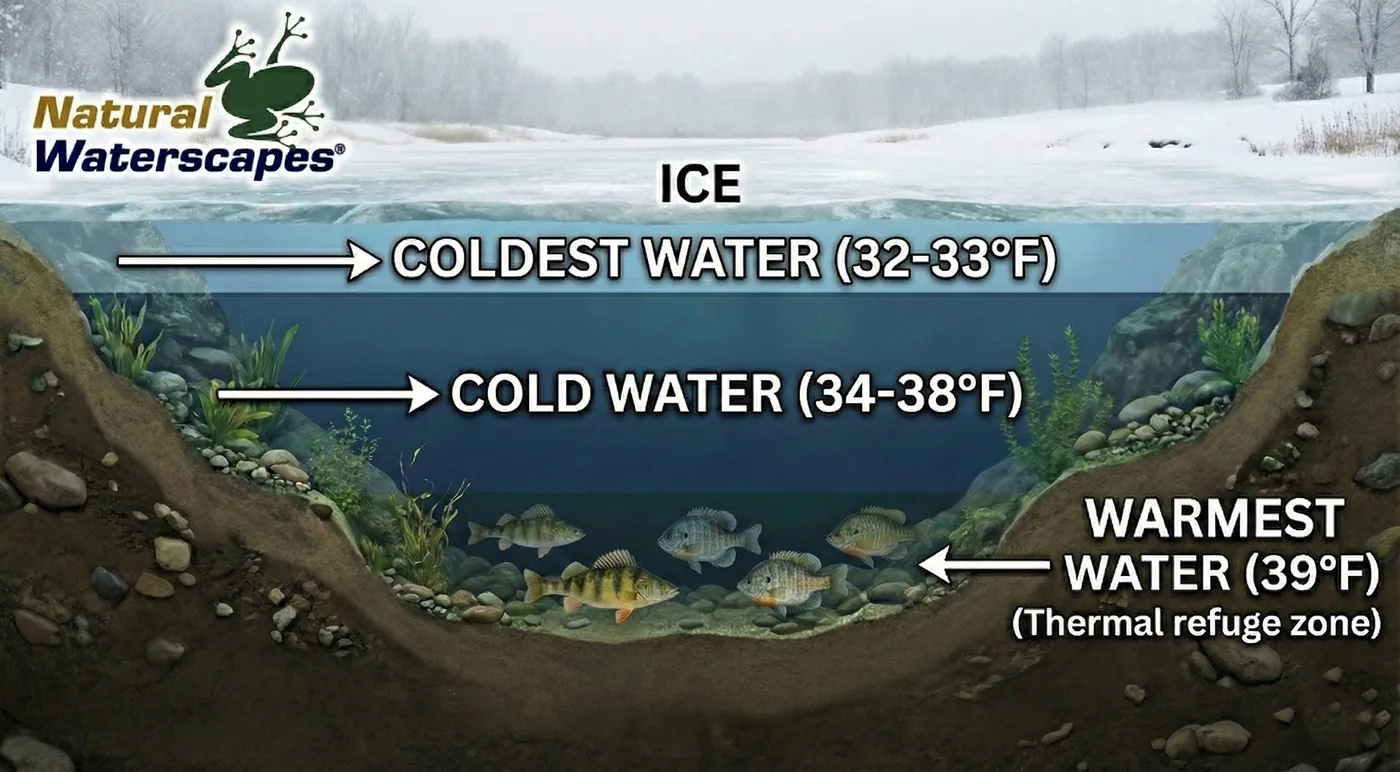
Fresh water reaches its maximum density at 39.2 degrees F (4 degrees C). That anomaly is what makes lakes survivable in winter: water colder than 39.2 F is less dense than water at 39.2 F, so it rises instead of sinking. The result is an inverse layering, with the coldest water and the ice at the top and the densest, comparatively warmest water resting on the bottom.
A de-icer is an axial propeller on a submerged motor, aimed so that it draws that bottom layer upward. The water arriving at the surface is only a few degrees above freezing, but a few degrees is the whole difference between ice and open water. Keep that circulation running and ice cannot establish over the area the unit reaches.
Everything that can go wrong with a de-icer follows from that single mechanism. No warm bottom layer, no de-icing.
How does a compressed-air bubble curtain work?
A bubble curtain puts no electricity in the water. A compressor sits on shore or on the dock and feeds air through weighted, perforated tubing laid on the bottom. Each rising bubble drags a column of water up with it, so a run of tubing lifts water along its entire length rather than radially from a single point.
The underlying trick is the same, moving deeper water to the surface, but the geometry differs. A de-icer opens a circle or an oblong from one point. A curtain opens a line.
Which one do you need?
The decision is driven mostly by depth and by the shape of what you are protecting.
| Your situation | Generally favors | Why |
|---|---|---|
| Water comfortably deeper than the manufacturer minimum, with winter stratification | Propeller de-icer | There is a warm bottom layer to draw on |
| Moderate depth, no warm bottom layer forming | Bubble curtain | Does not depend on stratification; needs about 4 ft or more to work in |
| Long linear runs: dock faces, shorelines, ferry lanes | Bubble curtain | Opens a line rather than a circle |
| Targeted protection: one slip, a boat lift, a piling cluster | Propeller de-icer | Directional and aimable |
| Tight corners, dock fingers, shoreline transitions | Propeller de-icer | Placed and angled around obstructions; sometimes supplements tubing |
| Large marina needing a wide open area | Multiple units, or a combination | Single-point coverage does not scale to a basin |
This selection logic is drawn from the project source review and is offered as guidance, not as a manufacturer specification.
How deep does the water need to be?
Kasco publishes a minimum water depth of 4 ft for every D-Series de-icer, from the 1/2 HP 2400D through the 1 HP 4400HD. That is the manufacturer's own figure and it is the number to design against.
Two things sit behind it. First, Kasco's published coverage figures assume conditions most private docks do not have: unobstructed water, a body of water over 200 acres, over 200 ft deep overall, and more than 4 ft of water in the de-icing area itself. Second, 4 ft is a floor rather than a target.
Our recommendation is 6 ft. Below roughly that depth the column mixes readily under wind and loses the stable warm bottom layer a de-icer depends on, so a unit in 4 ft of water can meet the specification and still open far less water than the coverage tables imply. Treat 4 ft as the manufacturer minimum and 6 ft as the depth at which the equipment behaves the way the chart says it will. See minimum water depth and scour risk for the full treatment, including why a unit set too low in shallow water starts moving bottom sediment.
Do bubblers cost less to run than de-icers?
We have not found measured figures that support it, so this site does not assert it.
The claim is repeated widely that bubble systems draw less power than propeller de-icers while costing more in installation labor. It is plausible, since a compressor and a de-icer motor are different machines with different duty profiles, but the sources making the claim are retailer blogs rather than measured comparisons, and no compressor power figures have been verified for this site.
A second problem applies to both technologies: manufacturers in this category publish amps, and buyers need dollars. Volts times amps yields apparent power in VA, which equals real power in watts only at a power factor of 1.0, and induction motors of this class run well below that. Any run-cost figure built on an amp rating alone overestimates by an unknown margin. See power draw and running cost.
What does a Kasco de-icer draw?
Verified against Kasco's current published specification tables. Apparent power is calculated from volts times amps and is not the same as real power consumption.
| Model | Size | Voltage | Running amps | Apparent power (VA) | Thrust |
|---|---|---|---|---|---|
| 2400D | 1/2 HP | 120V | 5.4 A | 648 VA | 31 lbs |
| 3400D | 3/4 HP | 120V | 6.6 A | 792 VA | 37 lbs |
| 3400HD | 3/4 HP | 208-240V | 3.1 A | 744 VA | 37 lbs |
| 4400D | 1 HP | 120V | 9.1 A | 1,092 VA | 42 lbs |
| 4400HD | 1 HP | 208-240V | 4.5 A | 1,080 VA | 42 lbs |
Note that several large resellers still publish 11.2 A and 52 lbs of thrust for the 1 HP 4400D. Those figures contradict Kasco's own current table and should be treated as stale. See the 4400D specification page.
Why can I not compare a Kasco to a Scott Aerator on the spec sheet?
Because the two manufacturers do not publish the same measurement. Kasco publishes thrust in pounds. Scott Aerator and U.S. Solar Mounts publish rpm and gallons per minute. Neither manufacturer explains what its figure predicts about open-water area, and the two are not interchangeable.
Thrust describes the force the unit imparts to the water column, which relates to how far it can push a plume. GPM describes volume moved, which relates to turnover. A unit can look better on one metric and worse on the other. Any comparison that sets thrust and GPM in adjacent columns and declares a winner is not a comparison. See the U.S. Solar Mounts reference, which also documents an unresolved question about whether that line shares an OEM with Scott Aerator.
Is it safe to walk on the ice near either system?
No. Both technologies work by destroying the ice sheet locally, and both leave a margin of thin, weak, unpredictable ice around the opening that can look continuous from shore.
Kasco states that no one should enter the water while equipment is operating or plugged in, that a GFCI-protected circuit should always be used, and that GFCI protection should be tested monthly. Signage and access control around any de-iced area are covered in safety around open water.